The title may seem a bit odd for a goat farm blog, and it should...but in this case, I'm writing to brag a bit about one of our two-legged "kids". Our daughter has always been quite artistic, and from a very young age always needed to have crayons, colored pencils, or paints handy for the many (and I do mean MANY) drawings she felt driven to create. During her college years, she pursued art classes both out of a love of learning and the desire to continue developing her natural talent in that area. Well, we're very, very proud to tell anyone who will listen that she has now illustrated her first children's book, very appropriately, a story about a mischievous little goat! Congratulations, dear daughter! You can learn more about the book at Campana Books! (Scroll down to the "Coming Soon" section and click on the Paco book cover.)
Wednesday, April 18, 2012
All those crayons paid off!
The Goatfarmer is out setting up a new pasture paddock for the does and our new crop of kids, so this is the Farmwife adding a post to the blog....
Saturday, March 10, 2012
Is It Spring Already?
I remember going to the pasture with the goats back on December 24th and taking the camera along to get some pictures of the late season pasture. Even though there was snow on the mountains, the goats had been going down there each day for several hours and foraging. On that day they looked around and went right back to the barn. It was tough getting a picture of them down there, but I did, as they headed back up the alley. I was all set to sit and write about the end of the pasture season but it seemed as though the time just slipped away with all the goings on. Truth be told, I am not a big fan of sitting at the computer and writing. The computer sits up in a spare bedroom and since we try to save energy the room is a bit cool. And mostly, it is at the end of the day that I have the most time to spend here, but have the least amount of creative juices flowing to write something that would have any value. Today is a bit different, it's 5 am and I am sitting here with a fresh cup of coffee while the Farmwife gets some more sleep.
Incredibly, it is also March 10th. The Winter season has flown by. We really didn't have much of a winter here and so the snowy days that could be spent at the computer actually turned out to be days spent cutting firewood. We have never had so much firewood at the end of the heating season as we will have this year. Actually, we are in a drought condition with the incredible lack of precipitation we are experiencing so far this year. Let's just hope to get back to "normal" weather for the rest of this year. Even though we are in a winter drought, the ground in the pastures is still saturated from last falls non-stop rain.
We also had a relatively mild winter. Very few days when we needed to have the heaters turned on to keep the water tubs free of ice. That made for the most challenges for cutting wood as the ground is incredibly soft. I also don't know how the open winter will affect the parasites that lurk in the pastures, most notably, the dreaded barberpole worm. We will see as we move forward into the grazing season which is still over a month away. Kidding season, however, is right around the corner and we have begun preparations for the new crop of kids we are waiting for. Right now we are refurbishing the buck lot. The shed is getting a residing job and the fences will get a good upgrade with some new poly-twine offsets to keep the bucks from escaping to spend more time with the ladies. As soon as the buck lot is complete they will move from the main barn and the spring barn cleaning begins and then we set up the kidding pens and before you know it the Farmwife will be taking pictures to post of new arrivals. Wow, there is a lot to do!
We are expecting the first kids to arrive about April 3rd or 4th. This year we will have only Kiko cross kids born here. The Boer buck never went with the herd. He went to the market. His kids last year didn't grow as well as the Kiko kids. We also have some of the Kikos that have not needed to be wormed. Quite an accomplishment in this environment, but certainly not without precedent. Dr. An Peischel, who raises Kikos in Tennessee has not needed to worm her goats in the past sixteen years! That is the result of her relentless selection for parasite resistance in her goats. This is certainly appealing to us since we don't like using all of those harsh chemical dewormers. We believe that there are opportunities to produce high quality goat meat without having to feed them lots of grain and dose them with chemicals to keep them alive. We want to have a sustainable operation here and the selection of the goats is the key.
I will make a greater effort to keep this blog updated more frequently now that there is more to report. We have some new seedings to try out this year and some improvement projects planned. We are looking down the road for the next few years to try a major upgrade of our forages here and try to get alfalfa growing again on this farm. That would make us able to produce all of our own protein needs here at the farm instead of having to purchase soybeans to supplement the hay at the end of pregnancy and beginning of lactation until the pasture season starts. The key seems to be to find ways to become more sustainable by using fewer outside inputs. It will have to become a way of life to search these opportunities out and put them in practice. At times, this can be quite a challenge, but it will pay huge dividends in the end.
Incredibly, it is also March 10th. The Winter season has flown by. We really didn't have much of a winter here and so the snowy days that could be spent at the computer actually turned out to be days spent cutting firewood. We have never had so much firewood at the end of the heating season as we will have this year. Actually, we are in a drought condition with the incredible lack of precipitation we are experiencing so far this year. Let's just hope to get back to "normal" weather for the rest of this year. Even though we are in a winter drought, the ground in the pastures is still saturated from last falls non-stop rain.
We also had a relatively mild winter. Very few days when we needed to have the heaters turned on to keep the water tubs free of ice. That made for the most challenges for cutting wood as the ground is incredibly soft. I also don't know how the open winter will affect the parasites that lurk in the pastures, most notably, the dreaded barberpole worm. We will see as we move forward into the grazing season which is still over a month away. Kidding season, however, is right around the corner and we have begun preparations for the new crop of kids we are waiting for. Right now we are refurbishing the buck lot. The shed is getting a residing job and the fences will get a good upgrade with some new poly-twine offsets to keep the bucks from escaping to spend more time with the ladies. As soon as the buck lot is complete they will move from the main barn and the spring barn cleaning begins and then we set up the kidding pens and before you know it the Farmwife will be taking pictures to post of new arrivals. Wow, there is a lot to do!
We are expecting the first kids to arrive about April 3rd or 4th. This year we will have only Kiko cross kids born here. The Boer buck never went with the herd. He went to the market. His kids last year didn't grow as well as the Kiko kids. We also have some of the Kikos that have not needed to be wormed. Quite an accomplishment in this environment, but certainly not without precedent. Dr. An Peischel, who raises Kikos in Tennessee has not needed to worm her goats in the past sixteen years! That is the result of her relentless selection for parasite resistance in her goats. This is certainly appealing to us since we don't like using all of those harsh chemical dewormers. We believe that there are opportunities to produce high quality goat meat without having to feed them lots of grain and dose them with chemicals to keep them alive. We want to have a sustainable operation here and the selection of the goats is the key.
I will make a greater effort to keep this blog updated more frequently now that there is more to report. We have some new seedings to try out this year and some improvement projects planned. We are looking down the road for the next few years to try a major upgrade of our forages here and try to get alfalfa growing again on this farm. That would make us able to produce all of our own protein needs here at the farm instead of having to purchase soybeans to supplement the hay at the end of pregnancy and beginning of lactation until the pasture season starts. The key seems to be to find ways to become more sustainable by using fewer outside inputs. It will have to become a way of life to search these opportunities out and put them in practice. At times, this can be quite a challenge, but it will pay huge dividends in the end.
Monday, November 28, 2011
Next Year's Kids are Already Started.....
We put the does with the bucks on the 4th of November. That means by the time you are reading this blog, the breeding season will be pretty much complete. In fact, as I sit to write this blog most of the does have been checked off the list as having been bred. There always seem to be a few that we never see particularly interested in the buck, but still have kids come spring. It has been our plan the past couple of years to have the does begin to kid as they were going out to the pasture in the spring. This year, we pushed the season a bit earlier, and will go back to kidding at the barn, so that the kids will be a little bigger when they go out to pasture with their mothers. We read an article in GOAT RANCHER by Dr. Dave Sparks that showed the results of a 5 year study indicating that kids born earlier in the spring simply grow better and have heavier weaning weights. We read the article too late to move the kidding back by more than a few weeks this year, but it is a trend in a new direction. This will be a new experiment for us, and you know that "Experiments Never Fail".
You also know from reading my previous blog that we will be using the 2 Kiko bucks on the entire herd. Donkey Odie will have the larger of the 2 groups with almost all of the older mature does. This group includes most of the older Boer does as well as all the older crossbred dairy does. We put them in this group to get them bred to a fairly large framed animal who can also provide a lot of parasite resistance for the kids. Donkey also throws a lot of color which the Farmwife says is an added benefit. Donkey produced some very nice growthy kids this past year and his doelings will form the core of a new generation when they are bred next year.
Survivor got a herd of younger does that are Donkey's daughters as well as a few purebred Boers. Survivor has the potential to add a lot of length to the kids he produces, as well as some very impressive parasite resistance. Being solid white himself, I don't see a lot of color potential, but for meat animals the color comes off and doesn't add value on the rail. Size and vigor do. Survivor has the potential to add that to his kids. Some of his doelings will be 75% Kiko and as we look down the road for a replacement for Donkey in the future these young does will play a part in that selection process.
As we move forward with our totally pasture based meat goat operation here at Sunny Acres Farm, we will be seeking out and selecting for those animals who can thrive under conditions of a forage only diet and produce a nicely muscled carcass that will be in demand in the market. Incredibly, in our first year of our totally pasture based management style we had better success than I had hoped for. Even with animals not specifically selected for this management style we had some very nice kids produced. Some, unfortunately, were not as thrifty, but that breeding is no longer an option here. Hybrid vigor combined with a higher level of parasite resistance for the animals that are raised in a "Management-intensive Grazing", forage based farm operation will be our way forward. We are choosing to produce a better product by purposeful design. Our customers deserve nothing but our very best!
You also know from reading my previous blog that we will be using the 2 Kiko bucks on the entire herd. Donkey Odie will have the larger of the 2 groups with almost all of the older mature does. This group includes most of the older Boer does as well as all the older crossbred dairy does. We put them in this group to get them bred to a fairly large framed animal who can also provide a lot of parasite resistance for the kids. Donkey also throws a lot of color which the Farmwife says is an added benefit. Donkey produced some very nice growthy kids this past year and his doelings will form the core of a new generation when they are bred next year.
Survivor got a herd of younger does that are Donkey's daughters as well as a few purebred Boers. Survivor has the potential to add a lot of length to the kids he produces, as well as some very impressive parasite resistance. Being solid white himself, I don't see a lot of color potential, but for meat animals the color comes off and doesn't add value on the rail. Size and vigor do. Survivor has the potential to add that to his kids. Some of his doelings will be 75% Kiko and as we look down the road for a replacement for Donkey in the future these young does will play a part in that selection process.
As we move forward with our totally pasture based meat goat operation here at Sunny Acres Farm, we will be seeking out and selecting for those animals who can thrive under conditions of a forage only diet and produce a nicely muscled carcass that will be in demand in the market. Incredibly, in our first year of our totally pasture based management style we had better success than I had hoped for. Even with animals not specifically selected for this management style we had some very nice kids produced. Some, unfortunately, were not as thrifty, but that breeding is no longer an option here. Hybrid vigor combined with a higher level of parasite resistance for the animals that are raised in a "Management-intensive Grazing", forage based farm operation will be our way forward. We are choosing to produce a better product by purposeful design. Our customers deserve nothing but our very best!
Sunday, November 13, 2011
Going, Going, Gone.....
Last Saturday, we put the does with the bucks. For those of you that are in tune with this simple statement, it means the breeding season has begun here at Sunny Acres Farm. A whole lot of thought goes into this process because next year's kid crop starts now. We have been thinking about this day for many months and now is when the plan goes into action. One buck that won't be getting a harem this year is Jasper. We are sadly phasing out of the Boers in favor of the Kikos. While it is true that the Boers often produce a nicer carcass for the butcher, they don't do as well as the Kikos under pasture management conditions. We are now a totally pasture based commercial meat goat operation. We need animals that will thrive under these conditions.
In 2002, we brought the first Boers to this farm. They had the first kids in the spring of '03. At that time I could buy bagged goat feed from Blue Seal for about $8 a bag. (These were 50 lb. bags) We were more than generous with the grain and the kids thrived and grew very well. As time went on and our herd increased, the price of grain was creeping up but we just kept feeding it and watched the kids grow very well. We even set up a creep feeder so they could have all they wanted without the mothers getting too fat. But, we only had about a dozen does and 25 kids a year and we could afford to buy all the feed we wanted on my salary. We never even calculated what it cost to produce a kid. That is not good business practice!
That was then, but this is now. I don't have a well paying off-farm job anymore. I was retired in January of '09 when my company needed to drastically reduce costs. I have a pension, but it does not cover grain for goats. We have expanded the doe herd a bit. Today we will put 32 does with the bucks and we have another 17 doelings that are being raised for the future. We cannot afford to feed these animals grain. It just is not in the equation. They have to manage on the grass that they can eat in the pasture. We have made an investment in improving that grass and that seems to be a better deal than buying grain. Today the bag of grain that cost $8 in 2003 costs over $14, and the price goes up at a steady rate. Economics dictates that we find a different path to produce goat meat that will allow us to earn a profit. Without a profit, there is really no point to going through the hard work of being a goat farmer.
This brings us back to the Boer-Kiko discussion. Without getting into all of the statistics, I can sum up our current year's kid crop, which we had on performance test. The kids at birth were very uniform with no real significant difference in weights or livability. At weaning we saw a slight advantage of the Kikos over the Boers and we attributed that to hybrid vigor, but it was most likely better resistance to the parasites that were an epidemic this year. It was after weaning that the spread really grew. The Kikos, for the most part gained at a better rate than the Boers. We were weighing all the kids and doing a Famacha check at least every other week. The Kikos had better Famacha scores and rates of gain than the Boers every time. The Boers were wormed much more frequently and were on intensive therapy to keep some of them alive when they were so wormy that they had a Famacha score of 5. The only kid that died this year was also a Boer that we were not able to save. Some of the Kikos have not been wormed except at weaning and have scores of 1-2. The kid herd was managed as a group, so they all got the same feed and opportunity to grow. The two photos below show the marked contrast between the Boer doeling in the front and the kiko/crossbred doelings behind. All were born within a couple of weeks of each other.
The group of doelings that is being kept for breeding next year is all Kikos. Their rate of gain, Famacha scores, and overall appearance is way better than any of the Boer doelings. The simple fact is that under our management system the Kikos are doing better. They will be our way forward. We are here to produce meat animals for a market that will not pay for inefficiencies in production. The prices are good for the animals we sell, but they would not support the feeding of grain to the herd to allow the Boers to stay and be a part of the make-up of the herd here at Sunny Acres. Reality is sometimes a very harsh fact of life.
In 2002, we brought the first Boers to this farm. They had the first kids in the spring of '03. At that time I could buy bagged goat feed from Blue Seal for about $8 a bag. (These were 50 lb. bags) We were more than generous with the grain and the kids thrived and grew very well. As time went on and our herd increased, the price of grain was creeping up but we just kept feeding it and watched the kids grow very well. We even set up a creep feeder so they could have all they wanted without the mothers getting too fat. But, we only had about a dozen does and 25 kids a year and we could afford to buy all the feed we wanted on my salary. We never even calculated what it cost to produce a kid. That is not good business practice!
That was then, but this is now. I don't have a well paying off-farm job anymore. I was retired in January of '09 when my company needed to drastically reduce costs. I have a pension, but it does not cover grain for goats. We have expanded the doe herd a bit. Today we will put 32 does with the bucks and we have another 17 doelings that are being raised for the future. We cannot afford to feed these animals grain. It just is not in the equation. They have to manage on the grass that they can eat in the pasture. We have made an investment in improving that grass and that seems to be a better deal than buying grain. Today the bag of grain that cost $8 in 2003 costs over $14, and the price goes up at a steady rate. Economics dictates that we find a different path to produce goat meat that will allow us to earn a profit. Without a profit, there is really no point to going through the hard work of being a goat farmer.
This brings us back to the Boer-Kiko discussion. Without getting into all of the statistics, I can sum up our current year's kid crop, which we had on performance test. The kids at birth were very uniform with no real significant difference in weights or livability. At weaning we saw a slight advantage of the Kikos over the Boers and we attributed that to hybrid vigor, but it was most likely better resistance to the parasites that were an epidemic this year. It was after weaning that the spread really grew. The Kikos, for the most part gained at a better rate than the Boers. We were weighing all the kids and doing a Famacha check at least every other week. The Kikos had better Famacha scores and rates of gain than the Boers every time. The Boers were wormed much more frequently and were on intensive therapy to keep some of them alive when they were so wormy that they had a Famacha score of 5. The only kid that died this year was also a Boer that we were not able to save. Some of the Kikos have not been wormed except at weaning and have scores of 1-2. The kid herd was managed as a group, so they all got the same feed and opportunity to grow. The two photos below show the marked contrast between the Boer doeling in the front and the kiko/crossbred doelings behind. All were born within a couple of weeks of each other.
The group of doelings that is being kept for breeding next year is all Kikos. Their rate of gain, Famacha scores, and overall appearance is way better than any of the Boer doelings. The simple fact is that under our management system the Kikos are doing better. They will be our way forward. We are here to produce meat animals for a market that will not pay for inefficiencies in production. The prices are good for the animals we sell, but they would not support the feeding of grain to the herd to allow the Boers to stay and be a part of the make-up of the herd here at Sunny Acres. Reality is sometimes a very harsh fact of life.
Sunday, October 16, 2011
Leader/Follower Grazing
According to Jim Gerrish in Management-intensive Grazing, the objective of leader/follower grazing is "to increase the biological efficiency of the pasture resource". In other words to get more out of the resources you have at hand. A pre-requisite for the program is to have at least 2 different classes of livestock with different needs to satisfy. The group with the greater needs leads the other, as they rotate across the pasture.
Here at Sunny Acres, we have a group of weaned kids that are in need of highly nutritious forage to maximize their potential for growth. They are not getting any supplemental grain to support their growth. They have hay and minerals available in the shed at night and whatever they can eat from the pasture during the day. The second group is the dry does who need to restore their body condition to prepare for the upcoming breeding season. They also have free choice hay and minerals in their shed at night, but no grain is available to them either. The does raised their kids without any grain supplementation and were a bit on the thin side at weaning.
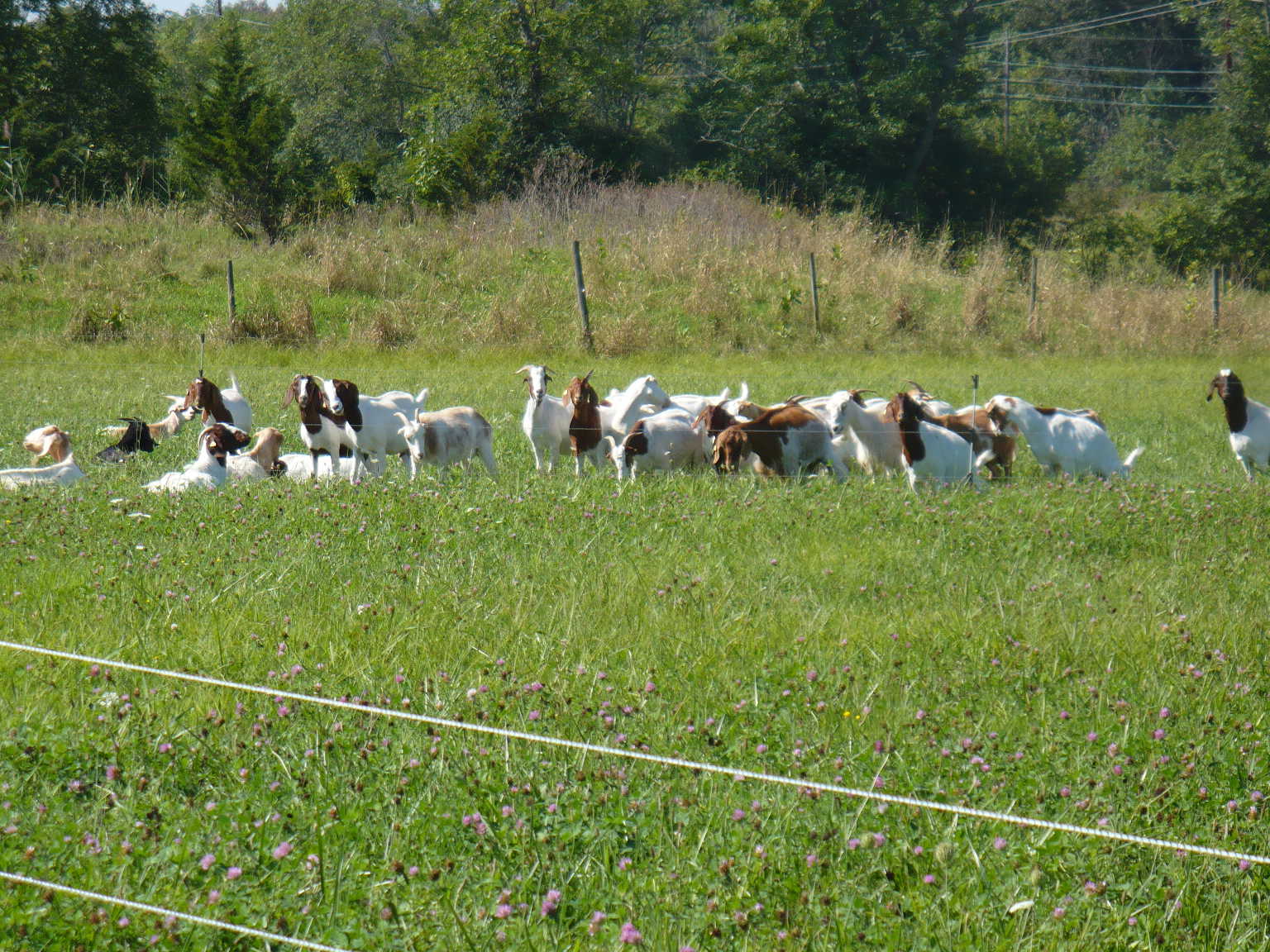
The pasture, as you can see in the photos, has a lot of legumes in it. We are fortunate to have quite a bit of trefoil along with the red clover. This pasture was grazed early in the summer and has had a couple of months of rest. There is lots of feed here, and hopefully not a lot of parasites!
We make the paddocks with a 3 strand polywire fence and step in posts. The paddocks are 32.5 feet wide and 225 feet long. That works out to about .17 acres each. The kids get the lead paddock for 1 day and then move forward. The does follow the next day on the same paddock as the kids have already eaten from. This way the kids get to eat the most nutritious parts of the plants and the does come in and finish it off. When the does leave, the paddock is fairly trampled and ready for another rest.
The kids began feeding in this pasture when they were weaned and the does were at the pond to separate them until the drying off process was complete. The kids couldn't utilize the forage very effectively though, since they couldn't eat enough in a day. The outcome was that they would stay in the same paddock for multiple days. The performance (ADG) suffered as a result. The pasture was also having animals on it for up to a week at a time. With leader/follower, the pasture only sees animals for 2 consecutive days and then rests. This should help stimulate better regrowth of the forage in preparation for one more quick pass at the end of fall.
Of course, this rotation is very intensive for us to manage. It requires leapfrogging a fence every day. We have 3 paddocks set up at any given time. One for the kids, one for the does and one being moved. The kids respect the 3 strands for the most part. Someone sneaks through on occasion to visit mom, but that is rare. They do have to be moved back and forth from the barns to the pasture separately though. That keeps the Farmwife and I in shape as we walk the 2 herds up and down the hill each day. Perhaps in the future they would stay put for the night and not return to the barn, but until we install predator proof fences we will not take the chance and they will sleep at night in the barn.
This weekend we plan to take everyone across the scale to see if this is really paying off. The does are all gaining in condition, that is very obvious and we should see significant gains from their weaning weights. Hopefully the kids will be increasing the average daily gain (ADG) over what we saw when they were first on pasture and only rotating every few days. The pasture looks like it is rebounding. If you look at the pictures of the pasture you can see the progression of new growth right up the hill. There is already nice feed available at the top of the of the hill with lots of nice new growth showing.
Here at Sunny Acres, we have a group of weaned kids that are in need of highly nutritious forage to maximize their potential for growth. They are not getting any supplemental grain to support their growth. They have hay and minerals available in the shed at night and whatever they can eat from the pasture during the day. The second group is the dry does who need to restore their body condition to prepare for the upcoming breeding season. They also have free choice hay and minerals in their shed at night, but no grain is available to them either. The does raised their kids without any grain supplementation and were a bit on the thin side at weaning.
The pasture, as you can see in the photos, has a lot of legumes in it. We are fortunate to have quite a bit of trefoil along with the red clover. This pasture was grazed early in the summer and has had a couple of months of rest. There is lots of feed here, and hopefully not a lot of parasites!
We make the paddocks with a 3 strand polywire fence and step in posts. The paddocks are 32.5 feet wide and 225 feet long. That works out to about .17 acres each. The kids get the lead paddock for 1 day and then move forward. The does follow the next day on the same paddock as the kids have already eaten from. This way the kids get to eat the most nutritious parts of the plants and the does come in and finish it off. When the does leave, the paddock is fairly trampled and ready for another rest.
The kids began feeding in this pasture when they were weaned and the does were at the pond to separate them until the drying off process was complete. The kids couldn't utilize the forage very effectively though, since they couldn't eat enough in a day. The outcome was that they would stay in the same paddock for multiple days. The performance (ADG) suffered as a result. The pasture was also having animals on it for up to a week at a time. With leader/follower, the pasture only sees animals for 2 consecutive days and then rests. This should help stimulate better regrowth of the forage in preparation for one more quick pass at the end of fall.
Of course, this rotation is very intensive for us to manage. It requires leapfrogging a fence every day. We have 3 paddocks set up at any given time. One for the kids, one for the does and one being moved. The kids respect the 3 strands for the most part. Someone sneaks through on occasion to visit mom, but that is rare. They do have to be moved back and forth from the barns to the pasture separately though. That keeps the Farmwife and I in shape as we walk the 2 herds up and down the hill each day. Perhaps in the future they would stay put for the night and not return to the barn, but until we install predator proof fences we will not take the chance and they will sleep at night in the barn.
This weekend we plan to take everyone across the scale to see if this is really paying off. The does are all gaining in condition, that is very obvious and we should see significant gains from their weaning weights. Hopefully the kids will be increasing the average daily gain (ADG) over what we saw when they were first on pasture and only rotating every few days. The pasture looks like it is rebounding. If you look at the pictures of the pasture you can see the progression of new growth right up the hill. There is already nice feed available at the top of the of the hill with lots of nice new growth showing.
Saturday, September 24, 2011
Experiments Never Fail !!!!!
Those are the immortal words of Max Elmore as he stated them in "THE MAX STRATEGY" by Dale Dauten. What you may ask, do they have to do with this blog? In a nutshell, everything. Let me explain.
Raising goats, and farming for that matter, have always seemed to be a fairly simple proposition. If you do this you should likely get that result. Of course the weather and various plagues can interfere with attaining your desired results, but for the most part you reap what you sow. The challenge here is that for millenia, the precedent to sowing was plowing. We as farmers became masters of plowing, whether it was behind an ox or horse, or one of the modern versions of the horse and you pulled your 16 bottom plow around with a 450 horsepower Case IH tractor. The end result was always the same, the soil on the top was buried under the soil that was on the bottom. It makes perfect sense to do this, doesn't it? After I sat through a presentation by Ray Archuleta of the NRCS last winter at the Annual Winter Green-Up Conference, I couldn't go out and put a plow to anything. He likened plowing to a volcanic eruption, tsunami, earthquake and tornado all at once to your soil microbes. It is your microbes and earthworms that indeed create that most precious of all resources, topsoil. Plowing literally destroys the topsoil and with it your future ability to grow crops. What is a caring farmer to do?
The answer to that dilemma is of course No-Till! Problem is that I don't own a single piece of equipment that was designed to plant anything right into the sod. And beyond that, how do you grow a crop like corn without eliminating all the competition? Spraying herbicides to kill everything on the field is NOT an option for me. This was the what I faced as I went through the summer and needed to improve some pasture that will be needed by the goats as we grow into the future. Enter Max and his dictum that "Experiments Never Fail".
Now, if you read my previous blog you can see me out on an obviously tilled field planting Triticale and Oats. That field has a very noxious weed on it named Nutsedge. Nutsedge is very persistent and difficult to control. That field was gone over with a set of discs to weaken the plants before planting. This field is a multi-year project to rejuvenate the plant species growing there. The field below that one has much less nutsedge, but could use an infusion of better varieties of pasture plants to make it more productive. The challenge came in that we did not want to destroy what was already there. The plan to renovate now became an experiment, and as we all know, "Experiments Never Fail"!
The goats even got a chance to help with this plan. The doe herd was put on this field and grazed across it in strips to eat it down as hard as they could. They did a great job at doing what they do best, eating. As soon as they had finished I went to work and "No-Tilled" some Creekside forage mix from King's Agriseeds right onto the existing sod. The key was the timing. I planted as soon as they were calling for several days of rain and steady showers. That should get the seed settled right down to the soil and give it enough moisture to germinate and start growing. The challenge here was that I have an old MF 33 grain drill that was not designed to plant into sod, but rather into a well prepared seedbed. The experiment is to see if by using the goats and timing the planting before a rain the new seeds will grow and add to the quality of the pasture. If that doesn't happen, at least we will know what not to do in the future. Experimenting with what we have and $300 worth of seed sure beats going out and plunking down $15,000 for a new "No-Till" drill that is specifically designed and built to plant crops right into the heaviest of sods.
So for now, all we have to do is wait and see what happens, and in the meantime spread a little compost on the fields to feed all those microbes and worms we have working for us out there. I hope they appreciate my willingness to give them a good home in exchange for improving the quality of the topsoil here at Sunny Acres. After all, it is that thin veil of living soil that feeds the world. We will do our best to preserve that for the future, even if it means thinking outside of the box on current wisdom and practice to do something different. At least we know for sure that no matter what, "Experiments Never Fail!".
Raising goats, and farming for that matter, have always seemed to be a fairly simple proposition. If you do this you should likely get that result. Of course the weather and various plagues can interfere with attaining your desired results, but for the most part you reap what you sow. The challenge here is that for millenia, the precedent to sowing was plowing. We as farmers became masters of plowing, whether it was behind an ox or horse, or one of the modern versions of the horse and you pulled your 16 bottom plow around with a 450 horsepower Case IH tractor. The end result was always the same, the soil on the top was buried under the soil that was on the bottom. It makes perfect sense to do this, doesn't it? After I sat through a presentation by Ray Archuleta of the NRCS last winter at the Annual Winter Green-Up Conference, I couldn't go out and put a plow to anything. He likened plowing to a volcanic eruption, tsunami, earthquake and tornado all at once to your soil microbes. It is your microbes and earthworms that indeed create that most precious of all resources, topsoil. Plowing literally destroys the topsoil and with it your future ability to grow crops. What is a caring farmer to do?
The answer to that dilemma is of course No-Till! Problem is that I don't own a single piece of equipment that was designed to plant anything right into the sod. And beyond that, how do you grow a crop like corn without eliminating all the competition? Spraying herbicides to kill everything on the field is NOT an option for me. This was the what I faced as I went through the summer and needed to improve some pasture that will be needed by the goats as we grow into the future. Enter Max and his dictum that "Experiments Never Fail".
Now, if you read my previous blog you can see me out on an obviously tilled field planting Triticale and Oats. That field has a very noxious weed on it named Nutsedge. Nutsedge is very persistent and difficult to control. That field was gone over with a set of discs to weaken the plants before planting. This field is a multi-year project to rejuvenate the plant species growing there. The field below that one has much less nutsedge, but could use an infusion of better varieties of pasture plants to make it more productive. The challenge came in that we did not want to destroy what was already there. The plan to renovate now became an experiment, and as we all know, "Experiments Never Fail"!
The goats even got a chance to help with this plan. The doe herd was put on this field and grazed across it in strips to eat it down as hard as they could. They did a great job at doing what they do best, eating. As soon as they had finished I went to work and "No-Tilled" some Creekside forage mix from King's Agriseeds right onto the existing sod. The key was the timing. I planted as soon as they were calling for several days of rain and steady showers. That should get the seed settled right down to the soil and give it enough moisture to germinate and start growing. The challenge here was that I have an old MF 33 grain drill that was not designed to plant into sod, but rather into a well prepared seedbed. The experiment is to see if by using the goats and timing the planting before a rain the new seeds will grow and add to the quality of the pasture. If that doesn't happen, at least we will know what not to do in the future. Experimenting with what we have and $300 worth of seed sure beats going out and plunking down $15,000 for a new "No-Till" drill that is specifically designed and built to plant crops right into the heaviest of sods.
So for now, all we have to do is wait and see what happens, and in the meantime spread a little compost on the fields to feed all those microbes and worms we have working for us out there. I hope they appreciate my willingness to give them a good home in exchange for improving the quality of the topsoil here at Sunny Acres. After all, it is that thin veil of living soil that feeds the world. We will do our best to preserve that for the future, even if it means thinking outside of the box on current wisdom and practice to do something different. At least we know for sure that no matter what, "Experiments Never Fail!".
Saturday, September 10, 2011
Summer's end is at hand.....
Many months ago when I last sat at this computer and wrote a blog I was finishing my class work for my Business Degree. I foolishly thought that I would now have lots of time for keeping up with the posting of new items in a timely manner. Who was I kidding!?! Myself, it turns out. The spring moved quickly into summer and with that all of the busyness of trying to get everything done that needed to be accomplished.
Today I can sit here and write because it is raining non-stop outside and I am at a standstill with all my projects until it stops or I can go and get some supplies for inside projects. Today's rain storm has a name, Lee. It is not as bad as last weeks storm, Irene that left us with 7 1/2 inches of rain in 24 hours. We were lucky! We only had water in the pasture, and even though it was more than anyone had ever seen it was gone in a few days. I am sure that most everyone has seen the devastation that was wreaked by that storm, so you will agree that indeed we were quite fortunate here at Sunny Acres. The bit of good fortune we had with the storm was that only the day before I had planted 6 acres of Tritical and Oats for late fall and early spring pasture for the goats. The wet and warm weather had it up and growing within days.
Working backwards through the summer is sort of like playing one of those Super 8 family movies in reverse. The most recent stuff is most vivid in the memory and the rest just sort of fades into the cobwebs that seem to be everywhere these days. We did have a very nice visit recently from Erin, of Heritage Foods, for the "No Goat Left Behind" promotion they are working on. We had a nice visit on a not so pleasant day (totally socked in with clouds and drizzle) and we got to share a lot of our story with them during the interview. We are planning to provide some market kids for their promotion this fall and they wanted to see the animals and the farm they are raised on. We are looking forward to this relationship and hope it leads to more opportunities for the meat goat industry in the Northeast.
Just prior to the visit from Erin, Dr. tatiana Stanton spent part of a day with us to gather the final data for the Cornell Lambing and Kidding Survey. We were participants for the first time this year and found it to be a great opportunity for learning and a lot of reflection about why we do some of the things we do. Of course we had a good year with relatively few problems and the ones we encountered seem to be behind us. We have changed some of our management practices to mitigate as many of these problems as possible and we will see if these changes are long term solutions, or just stop gap measures. More on these in other blogs as we see the long term results.
Another event of the summer we participated in was the Batavia Kill Stream Festival. We provided goat meat in several forms for the chefs associated with "Green Peas" TV to prepare and serve to the participants at the festival. I met one of the chefs, Noah Sheets, who is the executive chef for the Governor's mansion and who was preparing some of the dishes with the goat meat we provided through our friends at Pure Catskills. From what we heard, the event was a great success and the goat was a big hit. It is a great opportunity to get people who may have never tasted goat to get to try some in such a fantastic setting as this festival. Our hats are off to all those who worked so hard to make this event a success.
Of course, a major and necessary project this summer was the harvesting of the hay crop. Even though we were a little behind getting started because of the weather, we made great progress and put a very nice crop of hay in the barns. This is always a family project and my sons, son-in-law, and daughter-in-law were right there to put away each load as it came to the barn. We got every bale in without any damage from rain, which gave us a nice supply of very green, leafy hay to use and sell. We made a commitment to test this year's crop for nutrient value and our Extension Agent, Mick Bessire, loaned us a sampling probe and instructed us in the proper methods to get a good, representative sample. The samples have been sent off and we should be getting the results back soon, to let us know what we need to supplement with for the herd. Knowing this information will give us an opportunity to more efficiently maintain the animals.
The summer did seem to fly by with all of the day to day busyness of mowing lawns, planting and caring for the garden and even getting in a few days of leisure activity, such as taking the boat out on the river. It is hard to believe that it is now past and the garden is starting to wind down, the pool needs to be closed and the boat put away for the winter. But, the grass still grows like crazy, the pastures are still being rotated, seedings still need to be planted (rye as a cover crop for a new sweet corn patch) and goats need to be readied for marketing in the late fall. The day to day activities are still very much with us, even though the days are growing shorter. The time for wood cutting is upon us to prepare for winter's cold blasts. Second cutting hay beckons us from the fields across the tracks. Planning for next year is already in progress with anticipated seedings for the spring/summer season of 2012 and, most urgently, we need to finalize the breeding plan for the goats. Who will be with which buck and what will be our plan moving forward? Of course, these are all topics for blogs in the coming weeks and months ahead. Hopefully, I will make an effort to sit at the computer in the long evenings to come and share some of the thoughts which wander around in my mind on a daily basis.
Until next time, stay warm and dry.
Subscribe to:
Posts (Atom)