Wednesday, October 24, 2012

Making it easier to find us.....


Our new farm sign has been put up!  Hopefully this will help visitors to the farm locate us a bit easier.  We're very pleased with the way it came out, created for us by our (ok, we're a bragging a bit here....)  talented daughter!  

Monday, September 24, 2012

New Kids on the Block

 
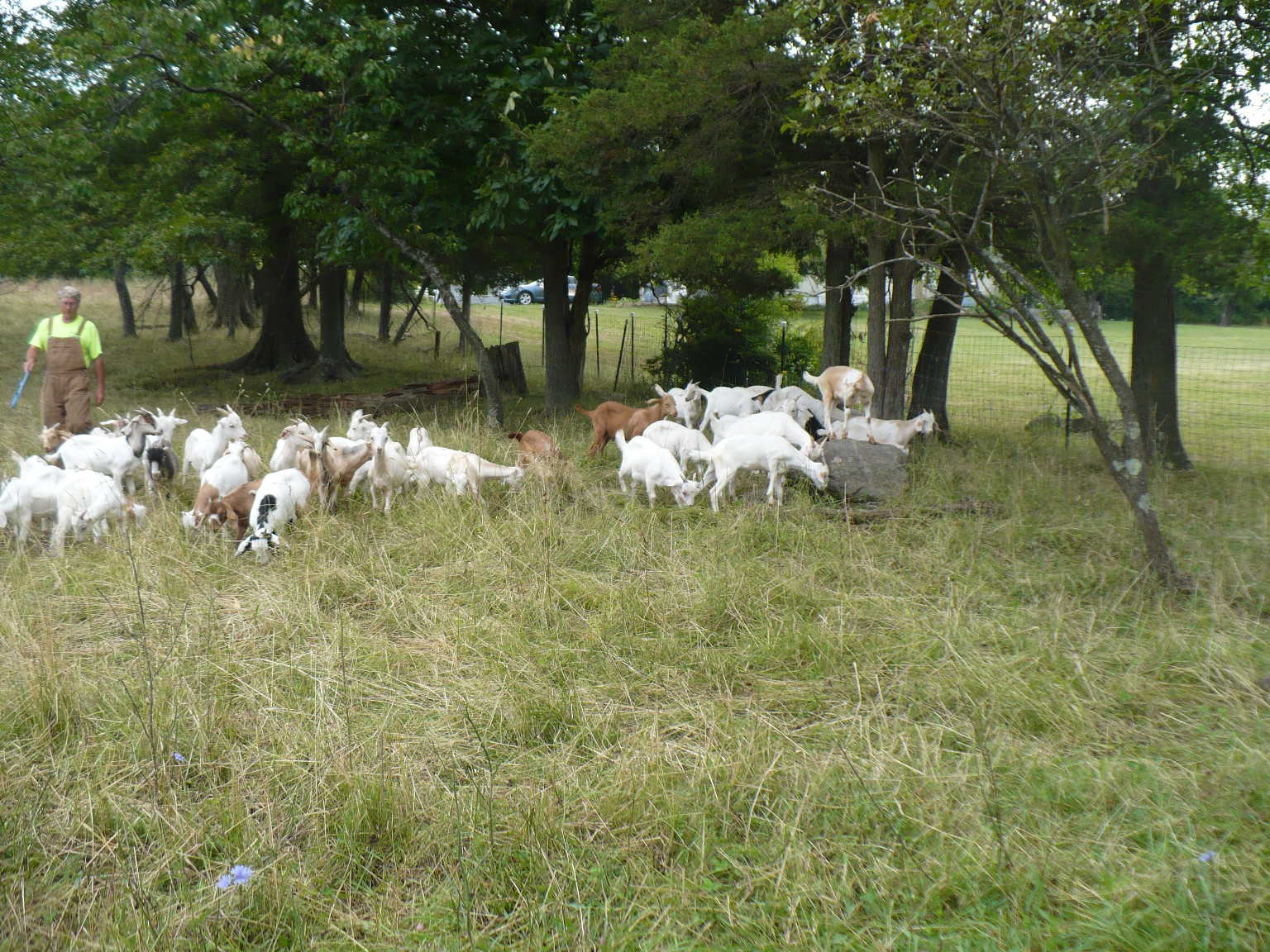
It has been a very busy summer here at Sunny Acres.  While the weather has at times been quite challenging, including two major hail storms that severely set back both our gardens and an annual pasture seeding, we still managed to put up more 1st and 2nd cutting hay than in years past.   We battled parasites in our herd of young kids, no doubt due to some very wet and warm weather throughout the spring and summer.  (Ironic, when you see all the reports of drought, but here in Athens we really didn't have prolonged dry spells.)  The kids were set back some due to the parasite issue, but are now rebounding well and are thriving on rotational pastures of regrowth grasses, clover, and trefoil. 

About a month ago, we took delivery of ten new kids....purebred Kikos....from Tennessee.  They come from "Goats Unlimited", the herd of Dr. An Peischel.  Anyone who studies the Kiko breed will recognize this herd, and Dr. Peischel, as a leading authority on Kikos.  She has an outstanding reputation for selecting and breeding excellent goats, through diligent culling and performance testing.  We were fortunate to be able to purchase a combination of purebred registered and purebred commercial doelings, along with a new purebred registered buckling to become part of our expanding Kiko herd.  These new doelings will not be bred until Fall 2013, as is the recommendation of Dr. Peischel, but the new buckling will be used against a small number of our current yearling does.  It is our hope that in the near future, we will be able to offer quality, purebred Kiko breeding stock to interested buyers, along with commercial and crossbred Kikos.


As always in farming, despite setbacks, we look to the future for better things to come.

Sunday, September 2, 2012

Kiko Buck for Sale

Looking for a buck that is ready to go to work breeding your does and can introduce parasite resistance into your herd?

We have just the one for you!  Offering for sale a purebred, AKGA registered Kiko buck.  A proven sire, Donkey Odie is a 4-1/2 yr. old, dark gray buck who has produced many daughters that we've kept in our herd, so now it is time to bring in a new buck.  Originally brought to Sunny Acres to breed our commercial Boer and Boer-cross does to add parasite resistance, he's done a tremendous job of that!  He has only been dewormed once (when we brought him home over three years ago), and his kids have shown wonderful resistance to parasites.  Some of them have not yet needed to be dewormed at all.  He also throws lots of color in his kids.  Some of his first doelings kidded this year, and they are producing kids that show the same positive characteristics.

See photos below of Donkey Odie and some of his offspring. You can contact us through our website if you'd like more information regarding this buck.   www.sunnyacresgoats.com


Wednesday, August 8, 2012

What's a "Typical Day"?


We were asked recently, "What's a typical day like on Sunny Acres Farm"?  After a slight chuckle at the idea of a "typical day" on any farm, the Goatfarmer gave the interviewer a general synopsis of his day, THAT day.  The particular day he was questioned, he was running flat out from sunrise to sunset, because along with the normal activities, there was hay to bale and get into the barn before a coming storm.


Saturday was another very busy day, but not at all like the one mentioned above.  Yes, the goats still had to be tended, and moved to their new paddocks.  That's about the only thing that really doesn't change, so I guess that would make it part of a routine or "typical" day.  However, for the three hours prior to taking them to pasture, both the Goatfarmer and Farmwife were working together evaluating the kids that were weaned last month, giving CD/T shots where needed, weighing them, doing Famacha scoring on each one, and deworming where absolutely necessary as dictated by their score.  We have worked out a pretty good system together, which involves running them into a chute for the individual scoring and any needed shots, etc., onto a scale, and out to a holding paddock.  Every score and weight is recorded (and later compared to their previous evaluation, done at weaning).  We've found that doing this every few weeks, often as frequently as every two weeks if we are seeing low scores, helps us catch problems before they get out of hand.  Though its a lot of work, it has paid off....last year we only lost one kid to apparent parasite problems, and (knock on wood!) this year all 50+ are doing very well so far! 


Since we are always seeking to learn new ways to better manage our herd, we decided to try something new yesterday, which we'd just recently heard from a very experienced producer.  We selected two of our yearling does who have not yet kidded, along with an old doe who no longer kids (yes, we do keep the occasional "pet" goat that no one can bear to part with!) and added them to the weaned kid group.  The paddock they are currently grazing is part of a 6-acre field, seeded this spring, of annuals...millet and forage brassicas (turnips).  This is a new forage mix we wanted to experiment with this year.  The kids are very unfamiliar with the new selections, and seem to be eating mainly the millet, which is high in energy, but not the brassicas, where the kids would get the most protein, needed for growth.  The idea here is that the older animals, experts at foraging and trying new things, will teach the kids to eat more of the turnips as well.  We'll watch them closely for a couple of days, and if need be, will add the entire doe herd to the group, hoping the kids will learn from their mothers.  Since they've been separated for over a month, there is less chance of  kids trying to nurse off their dams again.  The field will still be divided into small paddocks, with the herd being moved to fresh feed every few days.  The doe herd is currently enjoying browsing off a small area of overgrown field with lots of brush in it.

After finishing in the barn and grabbing some lunch, the Goatfarmer then took off to finish preparing another field for planting.  (See photo below.)  Today he's drilling in tillage radishes.  These will serve two purposes - providing the weather cooperates and they grow well, they'll be fall forage for the breeding herds.  And, because of their heavy and long roots, they'll nicely break up the soil as they grow, helping to loosen it up for a planting next spring, probably of another summer annual.  Eventually, the field will be planted to a perennial forage. This particular field is very heavy clay soil and needs to have this additional organic matter added to allow for a better long-term planting in the future.


But, it's not all work and no play.....after a long, hot day, we enjoyed a very pleasant evening with another couple, enjoying an evening swim and quiet conversation on our deck, gazing at the star-filled sky.  The night sounds of countless insects, along with the munching of the goats that were grazing in a nearby paddock are very peaceful and relaxing. We truly love living here on this farm, even with all the hard work and long days.  I guess that's why its been in the family for six generations now!

Wednesday, July 18, 2012

Weaning Day!


Yesterday was weaning day for the majority of our goat kids.  Only five of the later born kids are staying with the does for a couple more weeks.  The rest of the kids, currently numbering 47, have reached the age of 90 days and it was time for them to be on their own!

Prior to weaning, we spent a full day sorting and hands-on evaluating the entire herd.  We weighed every animal, and did Famacha checks of each one as they came through the chute to the scale.  Any showing a score of less than 3 were given a dose of dewormer.  We have been working hard at eliminating the need for any deworming by constant pasture rotation.  This year we also have been researching other methods of fighting the war against parasites.  One interesting idea was the use of copper oxide wire particles; several studies have shown that copper deficiency in goats causes a number of problems such as depressed immunity, poor reproductive performance, anemia, etc.  The use of copper has also been shown to help the goats fight the effect of parasites.  So, this year we've been giving each of our goats a bolus containing the copper oxide wire particles.  We purchase the large boluses from a vet supply company, along with empty gel caps of various sizes, and then refill and use the appropriate size according to the weight and age of the goat.  Each kid received a small bolus as part of the weaning regimen.  The kids also got their second CD/T shot, and the bucklings were all neutered.

Once the does had been taken to their new pasture, the newly weaned group was brought down to a secure pasture where they'll stay for a week or so until they acclimate to life without mom. In the third picture below, you can just barely make out the doe herd at the far end of the pasture.  This distance between the two herds dramatically reduces the stress on both the does and kids as they all adjust to the separation.


Just below the pasture where the kids are this week, is a field that was seeded early this summer with millet and  forage brassicas.  (Note the bright green field in the following photo.)  Once this reaches a height of about 12", the kids will be pastured on it until it starts to get ahead of them.  When the "Summer Feast" is getting too lush for the kids alone, the does will begin to share the pasture with close but separate paddocks.  This field will then have a permanent seeding put on it late summer/early fall.


Following this, the kids will be rotated through 2-3 day paddocks just ahead of the does, on regrowth from earlier pastures.  The kids will be able to benefit from the best forage, necessary for their optimal growth.  The does will follow, still finding more than enough feed to put condition back on them prior to fall breeding. It is incredible to see the improvement to the pastures by using this rotational method.  Paddocks where the goats grazed just about a month ago are thick with clover, trefoil, and grasses. 

Sunday, July 8, 2012


Sunday, July 8, 2012

Can you find the goats?


The summer has been charging forward at an amazing speed, and we have found very little time to add posts to this blog, but wanted to go back and share these photos from mid-June.


Look carefully at the following photos....can you find the five does and their five doelings in the grass? This paddock was grazed earlier this spring, then let rest for just about three weeks. The warm and wet weather we had surely made the grass grow! These goats are ones we'd just purchased and wanted to keep separate from our main herd for a week or so. After turning them into this paddock and watching them totally disappear, we were having second thoughts about how we'd be able to check them every day for any possible problems! Fortunately, they did very well and are now happily moving with the rest of the herd through our rotational grazing paddocks.


Wednesday, April 18, 2012

All those crayons paid off!

The Goatfarmer is out setting up a new pasture paddock for the does and our new crop of  kids, so this is the Farmwife adding a post to the blog....

The title may seem a bit odd for a goat farm blog, and it should...but in this case, I'm writing to brag a bit about one of our two-legged "kids".  Our daughter has always been quite artistic, and from a very young age always needed to have crayons, colored pencils, or paints handy for the many (and I do mean MANY) drawings she felt driven to create.  During her college years, she pursued art classes both out of a love of learning and the desire to continue developing her natural talent in that area.  Well, we're very, very proud to tell anyone who will listen that she has now illustrated her first children's book, very appropriately, a story about a mischievous little goat!  Congratulations, dear daughter!  You can learn more about the book at  Campana Books!  (Scroll down to the "Coming Soon" section and click on the Paco book cover.)